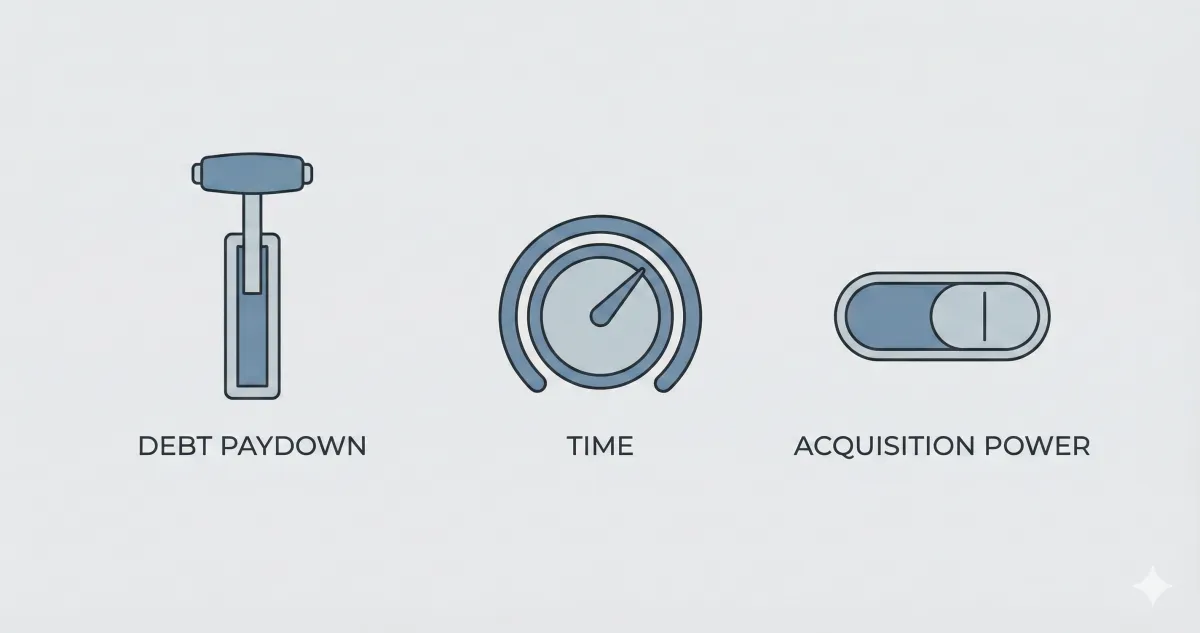
The Only Three Levers That Matter in Real Estate Wealth
Most people overcomplicate real estate. They obsess over decorative nonsense—granite vs. quartz, “up-and-coming” neighborhoods someone on YouTube mentioned, or whether they should wait six more months for the “perfect” market. None of that moves the needle.
If you strip away the noise, real estate wealth comes down to three levers. Pull them consistently, with discipline, and wealth becomes almost unavoidable. Ignore them, and you can buy a dozen properties and still end up spinning your wheels.
Let’s get into the only things that actually matter.
Lever 1: Buy Assets That Someone Else Pays Down for You
Forget the fantasy of hitting a home run on appreciation. The first real lever is much more boring—and far more reliable: principal paydown by your tenants.
When you buy a property with financing, every mortgage payment reduces your loan balance. If a tenant is covering that payment, you’re building equity without lifting a finger. It’s quiet, automatic wealth creation.
This is where most rookies screw up. They get seduced by cash flow spreadsheets and ignore the underlying math. A property that nets you $150 a month on paper isn’t exciting. But if the tenant is paying down $350/month in principal, you’re quietly gaining $500/month in total wealth. That’s $6,000 a year, often tax-advantaged.
And it compounds. Every property you add becomes another machine paying down debt on your behalf. After a decade, those machines start throwing off massive equity—even if prices barely move.
Ignore the social media noise. Debt paydown is the engine that never fails.
Lever 2: Control Time Because Time Does 80% of the Work
Time is the second lever, and it’s the one people treat like an optional ingredient—until they learn the hard way that it’s not.
Real estate rewards the patient, not the clever. Most investors underestimate how brutally consistent the long game is. Three things happen as time passes:
Your loan balance drops.
That’s forced equity, paid by someone else.Your rents rise.
Even conservative rent growth works miracles over 10–20 years.Your property value climbs—not because you’re a genius, but because inflation exists.
Time does the heavy lifting. But here’s the catch: you only benefit if you stay in the game. Constant buying and selling resets your clock. Over-optimization resets your clock. Fear of market cycles resets your clock.
Long-term wealth comes from holding high-quality properties long enough for compounding to work. Investors don’t get rich because they picked the best year to buy—they get rich because they picked a year to buy and didn’t quit.
If you respect this lever, even average deals become great. If you ignore it, even “amazing” deals disappoint.
Lever 3: Buy in a Way That Preserves Your Ability to Keep Buying
This is the lever almost nobody talks about, yet it determines whether you build a portfolio or get stuck at property number one.
Your ability to acquire more properties is the real accelerator of wealth.
You don’t build meaningful net worth with one door. You build it with multiple assets compounding simultaneously. But that only happens if you protect your ability to qualify for financing and maintain liquidity.
This means:
Buy properties with real cash flow, not spreadsheet fantasies.
Keep reserves that a lender won’t laugh at.
Avoid deals that look good in month one but turn into financial quicksand in month twelve.
Don’t chase appreciation plays that stretch your debt-to-income ratio to the breaking point.
Sophisticated investors don’t just ask, “Can I buy this?” They ask, “If I buy this, can I still buy the next one?”
The wrong property can trap you. The right property keeps the door open. And the difference between being a one-property hobbyist and a multi-property wealth-builder is night and day.
Everything Else Is Noise
Most of the real estate conversation is theater. People argue about:
Cosmetic finishes
Instagrammable renovations
Predicting interest rates
Micro-market speculation
How to “time the bottom”
None of this builds wealth. At best, it's entertainment. At worst, it distracts you from the only levers that matter.
Real wealth comes from:
Letting your tenants pay down your debt
Giving time enough runway to compound the equity
Protecting your ability to acquire more assets
If you pull these levers consistently, you’ll look wealthy in hindsight—because real estate compounds quietly, then suddenly.
The formula isn’t sexy. It’s not meant to be. It’s meant to work.
